About the Journal
KUDI: African Journal of Economic Development is a peer-reviewed academic journal dedicated to advancing rigorous and policy-relevant research on the structural evolution of African economies. The journal’s title reflects a clear intellectual commitment to examining long-term economic change beyond conventional development metrics, focusing instead on the processes and dynamics that shape structural transformation across the continent. The term KUDI, meaning “money” in Hausa, provides a culturally grounded identity that situates the journal within African intellectual traditions, while the subtitle ensures clarity, accessibility, and recognition within the global academic community.
The journal is published by Alafarika for Studies and Consultancy (Nigeria), an independent research and consulting institution committed to generating policy-relevant knowledge and advancing scholarly research on African economic and development issues. The institutional backing provides both academic legitimacy and strategic direction, ensuring that the journal remains anchored in African realities while maintaining international standards of scholarship.
KUDI will obtain International Standard Serial Numbers (ISSN) for both its print and online editions, ensuring formal recognition within global publishing systems. In addition, all published articles will be assigned Digital Object Identifiers (DOIs) through CrossRef, guaranteeing permanent accessibility, reliable citation, and seamless integration into international indexing platforms.
The journal is published biannually, with two issues per year. This publication frequency reflects a deliberate strategy to prioritise quality over volume, allowing sufficient time for rigorous peer review, careful editorial oversight, and consistent production standards. It also enables the journal to build a strong and credible publication record during its early development phase, laying the groundwork for future indexing and expansion.
KUDI will initially publish in English and Arabic, reflecting its commitment to bridging linguistic divides and expanding accessibility across African and global audiences. In subsequent phases, French may be incorporated to further strengthen inclusivity and engagement across Francophone Africa, thereby positioning the journal as a truly pan-African academic platform.
Aims and Scope
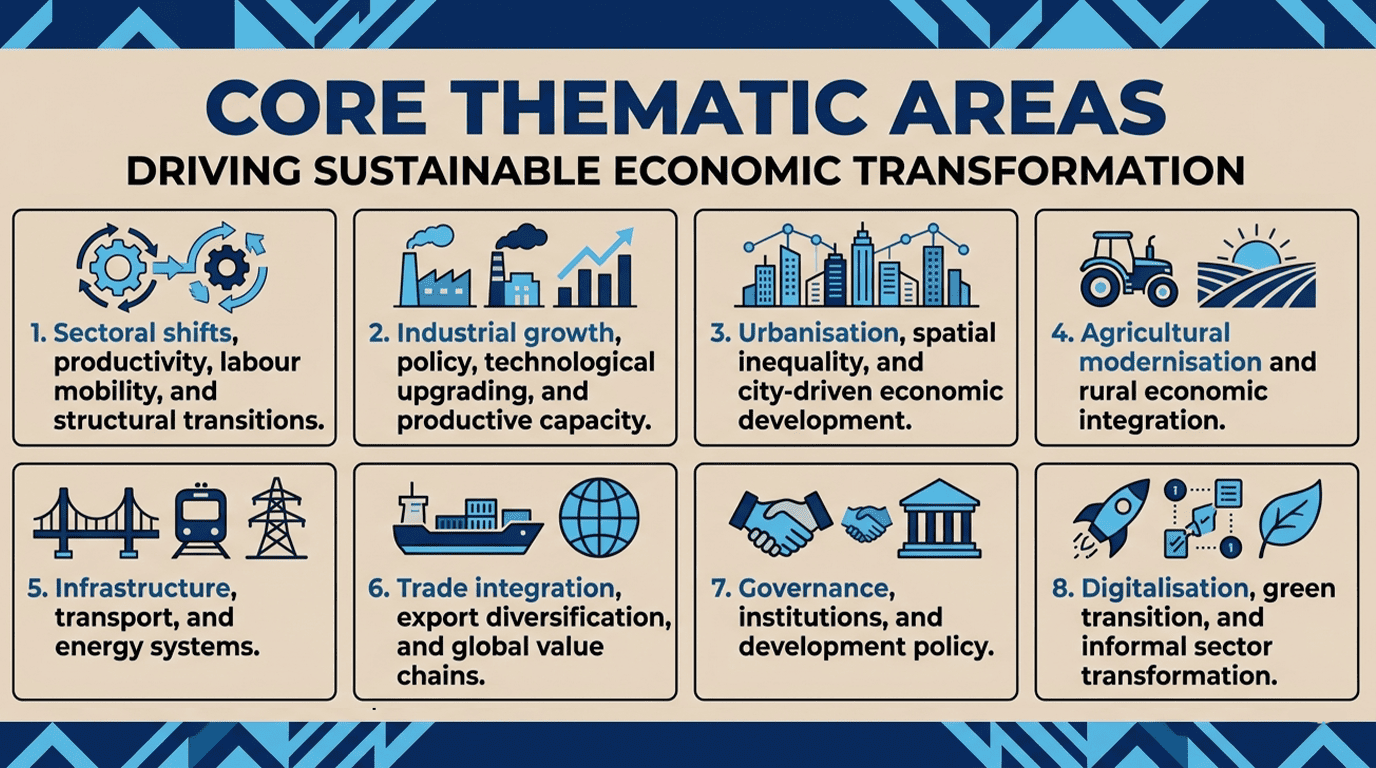
KUDI aims to publish high-quality, peer-reviewed research that advances understanding of economic development in Africa. The journal focuses on the structural, institutional, and sectoral processes that shape long-term development trajectories across the continent. It is grounded in the recognition that African economies are characterised by unique and complex structural realities, including dual rural–urban systems, large informal sectors, evolving industrial bases, demographic pressures, and rapid urbanisation.
The aims and scope could be summarised as the following:
- Publish high-quality, peer-reviewed research on economic development in Africa
- Focus on structural, institutional, and sectoral transformation processes
- Address African-specific economic realities:
- Dual rural–urban systems
- Large informal sectors
- Evolving industrial bases
- Demographic pressures
- Rapid urbanisation
- Emphasise development and transformation mechanisms and pathways beyond conventional indicators (e.g., GDP, poverty)
- Analyse sectoral transitions and evolution of productive capacities
- Examine the role of institutions and policies in shaping transformation
Research Orientation
- Accept theoretical, empirical, and interdisciplinary research
- Encourage advanced quantitative and qualitative methodologies
- Prioritise context-sensitive and Africa-focused research
- Promote research grounded in local and regional dynamics
- Emphasise structural and sectoral transformation analysis
- Support contributions that explain transformation processes in practice
- Incorporate historical, institutional, spatial, and socio-economic perspectives
Governance Structure
KUDI operates under a transparent and well-defined governance structure designed to ensure academic integrity, editorial independence, and efficient management. The editor-in-chief provides overall intellectual leadership, sets the strategic direction of the journal, and makes final decisions on all manuscripts. The Managing Editor oversees the daily operations, manages the submission system, and coordinates communication among authors, reviewers, and editors.
Associate Editors are appointed based on thematic expertise and are responsible for handling submissions within specific areas aligned with the journal’s scope. They manage the peer review process and ensure that all submissions meet the required academic and methodological standards. The Editorial Board consists of internationally recognised scholars who contribute to the journal’s academic quality, support peer review, and enhance its global visibility. An advisory board may also be established to provide strategic guidance, strengthen institutional partnerships, and ensure the journal’s relevance to both academic and policy communities.
Production & Design Unit
The Production and Design Unit ensures that all published content meets high standards of clarity, consistency, and professional presentation. The production editor oversees the post-acceptance process, ensuring that manuscripts are properly prepared for publication and that all outputs adhere to the journal’s formatting and quality standards.
The copyeditor or language editor refines the academic language of manuscripts, ensuring clarity, coherence, and consistency in style and referencing. The layout and typesetting specialist prepares manuscripts for publication by applying the journal’s formatting template and producing publication-ready outputs. Where appropriate, a graphic designer supports the journal’s visual identity, including cover design and communication materials, ensuring a professional and consistent presentation.
Peer Review System
KUDI employs a rigorous double-blind peer review process to ensure fairness, objectivity, and scholarly quality. All submissions undergo an initial editorial screening before being assigned to two or three independent reviewers with relevant expertise. Manuscripts are evaluated based on originality, methodological rigour, contribution to knowledge, and relevance to economic development in Africa.
Based on reviewers’ reports and editorial assessment, manuscripts are subject to clear decisions: acceptance, minor revision, major revision, or rejection. The journal aims to complete the initial review process within 6 to 8 weeks, balancing efficiency with academic rigour.
Author Guidelines
KUDI accepts only original and unpublished manuscripts that are not under consideration elsewhere. Submissions must follow a standard academic structure, including title, abstract, keywords, introduction, literature review, methodology, results, discussion, conclusion, and references.
Manuscripts should adhere to a recognised referencing style, preferably APA (7th edition) or an equivalent standard. All submissions must be prepared in Microsoft Word format (.docx), with clear formatting, properly labelled tables and figures, and consistent citation practices. Authors may submit manuscripts in English or Arabic, with future expansion to French. For more information, see the Author Guidelines page.
Publication Ethics
KUDI is committed to upholding the highest standards of research integrity and ethical publishing. All submissions are screened for plagiarism using recognised tools, and authors are required to disclose any conflicts of interest. The journal follows clear procedures for handling ethical issues, including corrections, retractions, and complaints.
KUDI complies with applicable Nigerian laws, relevant regional frameworks, and international standards in academic publishing. Its policies align with the principles of the Committee on Publication Ethics, ensuring transparency, accountability, and integrity.
Technical Infrastructure
KUDI operates on Open Journal Systems, providing a robust platform for submission, peer review, and publication. All articles are assigned DOIs through CrossRef, and structured metadata is maintained to enhance discoverability. The journal also adopts recognised digital archiving practices to ensure long-term preservation and accessibility.
Indexing Strategy
KUDI follows a phased indexing strategy. In the first year, the focus is on establishing a consistent publication record and visibility through Google Scholar. In the second year, the journal aims for inclusion in the Directory of Open Access Journals. From the third year onward, the journal will pursue inclusion in Scopus, followed by Web of Science, reflecting its commitment to international recognition
Issue Structure
Each issue begins with an editorial note that provides context and highlights key themes. The core content consists of 6 to 10 research articles presenting original contributions. Review articles may be included to synthesise emerging areas, while policy papers may be published to bridge research and practice.
Editorial Strategy
KUDI adopts a selective and quality-driven editorial approach, with a desk rejection rate exceeding 50% to ensure that only relevant and high-quality manuscripts proceed to peer review. The journal emphasises methodological rigour, originality, and policy relevance.
To strengthen its intellectual identity, KUDI actively promotes thematic special issues focusing on industrialisation, urban transformation, infrastructure development, and structural change. These issues serve as platforms for advancing focused academic and policy debates, positioning the journal as a leading voice in African economic development research.
Submission Fee Policy
All articles are published under a Creative Commons Attribution (CC-BY) licence. The publisher Alafarika adopts open access for all its journals, thus committing to making research accessible to all readers and researchers, without financial barriers.
- Submitting articles is free for authors during the initial phase of this journal (2026-2027).
- Alafarika is in contact with organisations and institutions for sponsorship to help African authors offset publication costs and thus make publication free for all Africans.
- However, pending securing the sponsorship and partnership (and after the initial phase), African authors (from African institutions) will pay a moderate submission fee upon introduction, which will be designed to support researchers from low-income African countries while maintaining high publication standards, supporting the peer review process, and compensating reviewers.
- For international authors (authors affiliated with non-African institutions), a publication fee (APC) will be applied (after the initial phase) when submitting the submission fee.